
Bug gave me nightmares. That means this play was so disturbing that it leap-frogged from the back of my subconscious to the front of my tired mind—beating out the spread of fascism, the normalization of the $6 pepperoni slice, and the vilification of the em dashes—as shit I needed to process, contextualize, and make sense of in my torrid brain at 3:00 AM. Seriously, Bug. That’s messed up.
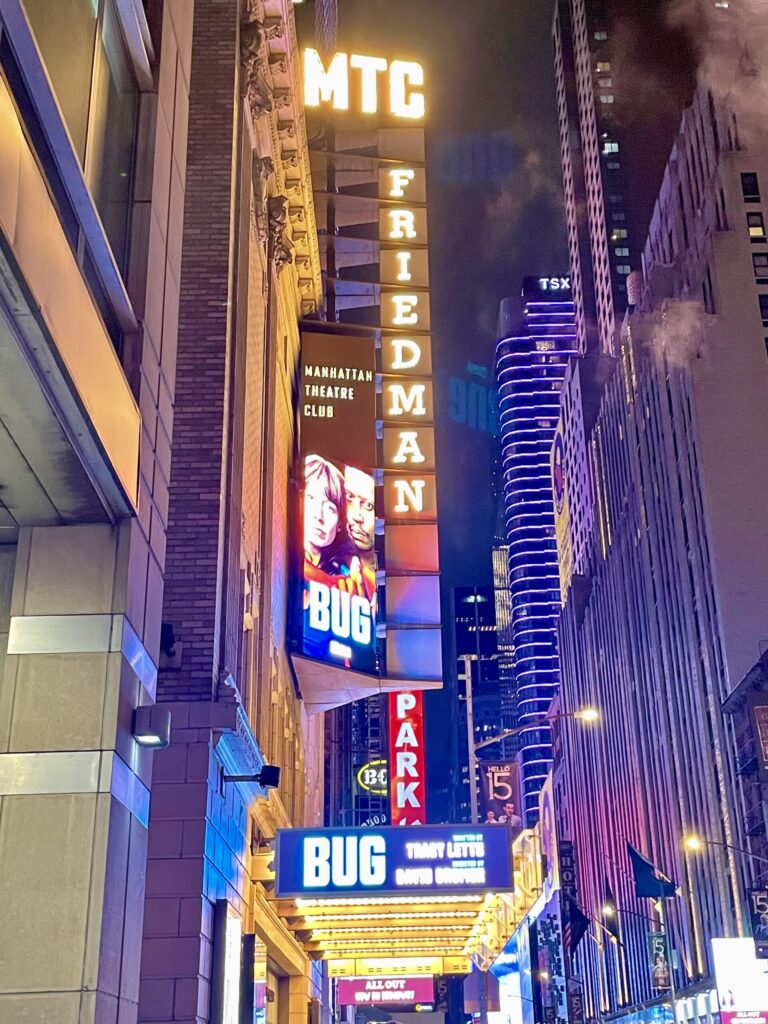
Like many New Yorkers who have lived in this challenging morass of humanity for a long time and hustled all hours of the day and night to afford rent, I’ve encountered my fair share of sadly and seriously mentally ill folks. The feces. The invisible demons. The rage of the unreal. Bug is about those tragically tortured souls. Yes, similar versions of the characters in Bug are probably on the D Train right now, which makes Bug feel disturbingly real, profound, and—somewhere—nearby. Nevertheless, being locked in a dingy motel room with these haunted spirits for a couple of hours at the Samuel J. Friedman Theatre truly screwed with my head.
I should have guessed I was in for a mind scramble when a theater staff member braved the frigid sidewalk temperatures to distribute Yondr pouches to the long line of theatergoers to sedate our phones. The theater strictly prohibited taking photos or videos, ostensibly, to protect the nude actors from being exploited by creepy adults who get all weird about naked people. But my conspiracy mind also thinks the pouches were to protect the general public from the sheer madness of Bug that, like a deadly virus in a remote biological lab, needed to be contained within the protective confines of the theater walls.
Nightmares aren’t contagious, are they? But, yeah, forget about the nudity. The real danger of Bug is what it does to your sanity.
Tracy Letts is the playwright, and Tracy, if for some reason you are reading this, maybe write a show about a mind-melting Broadway experience that escapes a theater and goes viral, then manifests into a crazed Godzilla-esque creature, violently stomping its way across the planet. But, please, no more bugs in our blood. And Tracy, you should know that nothing terrorizes New Yorkers more than the thought of bed bugs. Seriously, stop it. Roscoe the bed bug dog already has his paws full.
The Setup: A Room with a View (of Hell)
For the record, Bug debuted in London in 1996. This more contemporary interpretation feels like a skin-scratching smash up of David Lynch on meth in a spiritual drum circle with paranoid Waiting for Godot characters and hungover motorcycle gangs and bipolar soccer moms—all wrapped in a skin of aluminum foil and dropped into the Manhattan Theatre Club in Midtown.
The story is set in a seedy Oklahoma motel room, where the eyes of the audience can smell the stale Marlboros and desperation. The plot centers on Agnes White (Carrie Coon). Agnes is a cocktail waitress hiding out from her abusive ex-husband, Jerry Goss (Steve Key), who just got out of prison. She’s lonely, she’s high on whatever’s available, and she’s ripe for the picking when a drifter named Peter (Namir Smallwood) walks through the door.
Smallwood plays Peter with a quiet, vibrating intensity that makes you want to back away slowly while simultaneously offering him a sandwich. He’s a Gulf War veteran who claims to have been a victim of government experiments involving microscopic bugs. Initially, Agnes—and the audience—think Peter is just a “quirky” guy with some baggage. But as the blue light of the motel sign flickers, Peter’s paranoia begins to infect Agnes like a biological weapon. Kurt Vonnegut once described loneliness as a “terrible disease” and I couldn’t help but think of those words while watching Agnes’s attempt to escape loneliness by embarking on a path to madness.
The Descent: Coon and Smallwood
Let’s pull the lens back a bit and talk about Carrie Coon. She is, quite simply, the GOAT. As Letts’s real-life wife, she understands the rhythmic, percussive violence of his dialogue better than anyone. She portrays Agnes not as a caricature of “white trash,” but as a woman so hollowed out by life that she’ll latch onto a conspiracy theory just to feel like she’s part of something. I think we can all relate to that thought process, even if we won’t admit it.
When the “bugs” arrive—invisible to us, but painfully real to them—the play shifts from a gritty character study into a full-blown body-horror nightmare. Smallwood and Coon’s chemistry is terrifying. They don’t just fall in love; they fall into a shared psychosis. By the second act, the stage is literally covered in flypaper and aluminum foil—an attempt to keep the “signals” out—and the two leads are spiraling toward a climax that is as inevitable as it is sickening.
And one that will give you nightmares.
The Supporting Cast: Realism in the Ruins
While the show is a two-hander at its heart, the supporting players ground the insanity in a scary reality:
- Steve Key (Jerry Goss): He brings a menacing, blue-collar physicality to Agnes’s ex. He represents the “real” danger of the world, which makes Peter’s “imaginary” danger feel even more complex.
- Jennifer Engstrom (RC): As Agnes’s lesbian best friend, she provides the only voice of reason in the room. When she looks at the foil-covered walls and sees the madness for what it is, she’s basically the stand-in for every sane person in the audience screaming, “Get out of there!”
- The Set Design: Scott Pask’s set is a character in itself. It captures that specific brand of American hopelessness found in roadside motels where the carpet feels sticky even from the tenth row.
Why This Matters for the Bros
Bros may think there is nothing edgy, tough, or “dude, what the fuck?” about Broadway. But there is. There is lots of all of that. The uninitiated may see Broadway only in terms of jazz hands and men in tights dancing with canes or maybe some “prestige” drama. Bug isn’t that. Not even close. Bug is a visceral, high-octane assault on the senses. It deals with the very things we’re seeing in our social media feeds every day: the death of objective truth, the way trauma makes us vulnerable to lies, and the terrifying speed at which a person can lose their grip on reality.
It’s a play about “The Great They”—the shadowy forces we blame for our shitty lives. In 1996, it was a cult thriller. But in 2026, it feels more like a documentary. The ending doesn’t just “wrap up”; it explodes. You’ll leave the theater checking your skin for itches that aren’t there and wondering if the person sitting next to you is a government plant.
MTC took a huge risk putting this on the Friedman stage, and it paid off. It’s loud, it’s naked (literally), and it’s deeply, profoundly upsetting. If you want to feel something other than the numb malaise of modern existence, go see Bug. Just don’t expect to sleep afterward.
See you under the marquee. – Jim Thompson