Broadway has always been a beacon of truth. As mainstream news, traditional media, and our established artforms (don’t get me started on country music) struggle to tell the authentic stories of who we are, there are fewer and fewer places we can go to experience the stories that reflect our real world and the genuine America.
Something about the theater experience and Midtown Manhattan makes it resistant to the hegemony taking over our culture. Perhaps Broadway’s long history of embracing diversity and truthtelling through art and song accounts for its resilience, but whatever it is, I’m so grateful Broadway never backs down.
Ragtime is brutal. And beautiful. And heartbreaking. The story, the characters, and the themes represent America at its best, its worst, and its most compelling. An affluent entitled white family, a struggling young black family, and a widowed Jewish immigrant father trying to build a new life for his daughter—these are the people we see in America.
In New York City, we see the wealthy shopping for antiques on Fifth Avenue, we witness the struggling as they pedal Amazon bikes through heat and snow, and we watch immigrant parents selling candy on the D Train with their babies strapped to their backs. Ragtime is very much alive today, as are the narratives that make it so tangible: how racism destroys communities, how structural institutions undermine individual good intentions, and how life is unfair, people are cruel, and why we all need Broadway to keep doing its thing.
The Dawn of a New Era
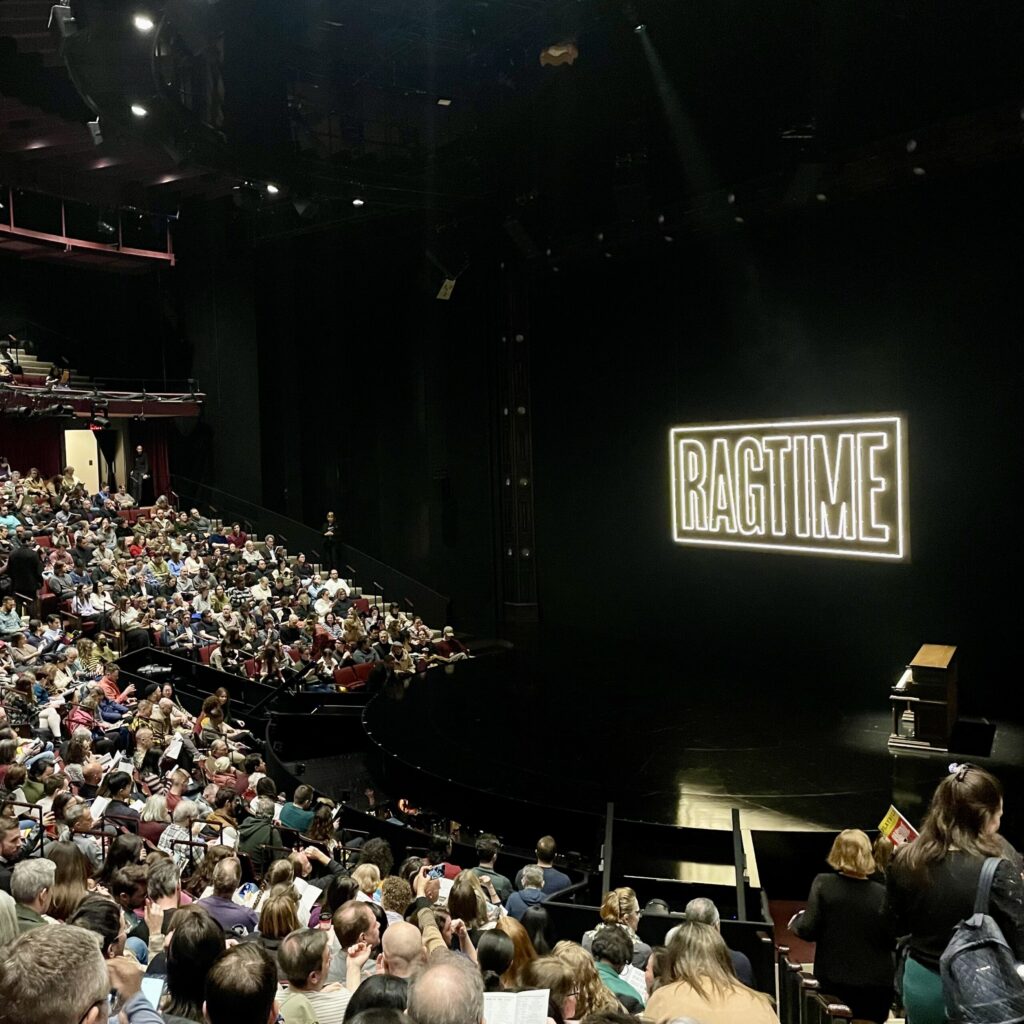
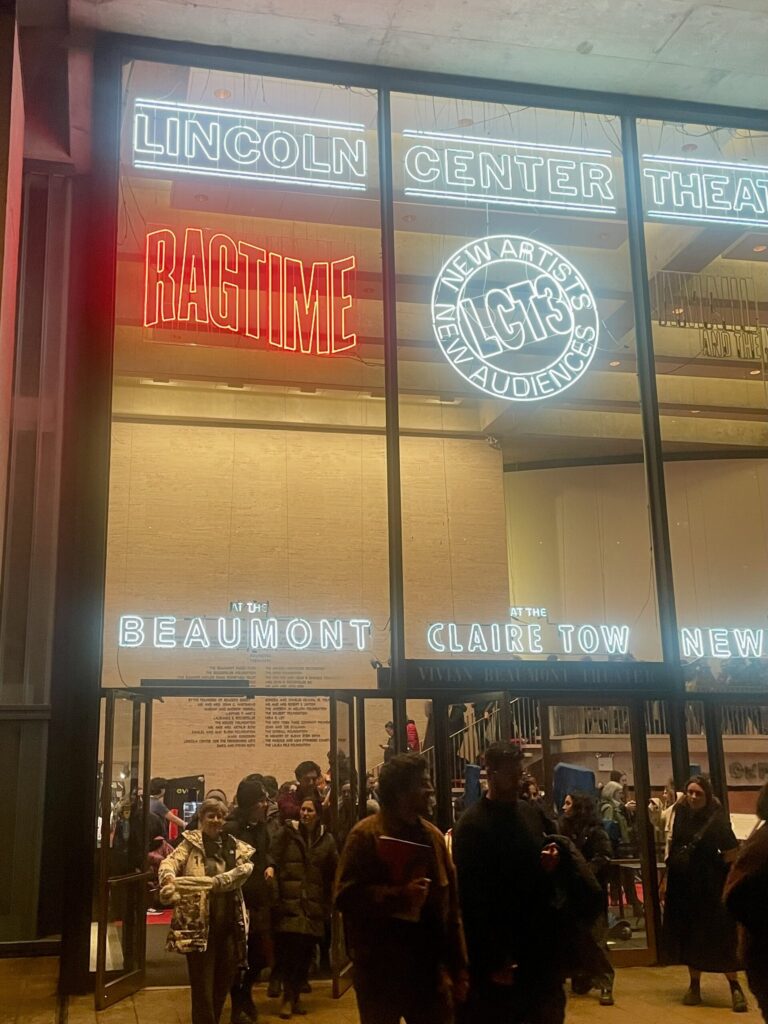
This 2026 revival at the Vivian Beaumont Theater, directed by Lear deBessonet, reminds us why this musical is arguably the “Great American Opera.” Based on the 1975 novel by E.L. Doctorow, the show weaves a complex tapestry of the early 20th century. We follow three distinct families: Mother’s wealthy Protestant family in New Rochelle, Tateh’s Latvian Jewish immigrant duo with his daughter, and the Harlem musician Coalhouse Walker Jr. and his beloved Sarah.
What makes Ragtime historically significant—and this production particularly sharp—is the integration of real-life figures like Emma Goldman, Harry Houdini, and Booker T. Washington. They aren’t gratuitous cameos but real historical figures who drove the gears of history. When Shaina Taub’s Emma Goldman belts about the “Success” of the wealthy being built on the backs of the poor, it doesn’t feel like a history lesson from 1906. It feels like a Bluesky thread from 2026, but with better melodies.
Performances That Shake the Foundation
The casting for this run is pretty legendary. Joshua Henry as Coalhouse Walker Jr. is the gravitational center of the show. When he sings “Make Them Hear You,” you hear a powerful demand for dignity that vibrates through the very floorboards of the Beaumont. Henry captures the transformation of a hopeful musician into a man radicalized by the systemic destruction of his life and his love. And if you didn’t know that Ragtime enjoys legions of devoted fans, you will upon the end of this song.
Opposite Henry, Caissie Levy delivers a career-defining performance as Mother. Her journey is the quietest but perhaps the most radical. In an era where “tradition” was a cage, Levy portrays Mother’s awakening with a steely, grounded grace. When she reaches the climax of “Back to Before,” declaring that the world she once knew is gone, she isn’t just singing about the 1900s—she’s singing for every person who realizes they can no longer ignore the injustice in their own backyard.
Brandon Uranowitz as Tateh provides the heart and the hustle. His transition from a desperate immigrant on the silhouettes of the street to a pioneer of the “moving picture” industry captures the bittersweet American Dream—the idea that you can reinvent yourself, provided you’re willing to lose your past. In many ways the American Dream and the bright lights of Broadway attract the most ambitious, interesting, and talented people from all over the world. But, as we all know, luck is capricious, and every dream needs luck on its side.
A Masterclass in Scale
On stage, the creative team opted for a “minimalist epic” approach. David Korins’ set design utilizes a massive, skeletal structure that reflects the industrial bones of a growing nation, while James Moore conducts a staggering 28-piece orchestra. Hearing Stephen Flaherty’s lush, ragtime-infused score and Lynn Ahrens’ poignant lyrics played by an orchestra of that size is a rare privilege in an age of synthesized tracks.
The Prologue remains one of the greatest opening numbers in musical theater history. It sets the stage for a world where different races and classes walk past each other, wary and isolated, until the “new music” of the era forces their lives to collide.
Here is a breakdown of those characters and themes:
| Character | Performer | Representative Theme |
| Coalhouse Walker Jr. | Joshua Henry | Justice and the “Wheels of a Dream” |
| Mother | Caissie Levy | Independent Awakening |
| Tateh | Brandon Uranowitz | The Immigrant Reinvention |
| Sarah | Nichelle Lewis | Hope and Heartbreak |
Why It Matters Now
The original 1998 production was a spectacle of the Clinton-era “End of History” optimism. But in 2026, the show feels more like a warning. When we see the fire chief, Willie Conklin, destroy Coalhouse’s Model T simply because he can, we see the modern echoes of petty, unchecked power. When we see Sarah (played with devastating vulnerability by Nichelle Lewis) lose her life to a misunderstanding by “security,” we see the headlines of today.
Ragtime doesn’t offer easy answers. It doesn’t end with everyone holding hands. It ends with a new generation—the Little Boy, the Little Girl, and the “youngest” son—trying to figure out what kind of country they’ve inherited. (Aren’t we all.) It’s a show that demands you look at where we’ve been to understand how we got here. And, sadly, understand why, in many profound ways, nothing has changed in America. For anyone.
So, if you want a show that has something tough, but relevant, to say—something that isn’t mainstream, celebrity-driven hype or a contrived, corporate cash-grab for your applause—Ragtime is it. The story is a gut-punch. But the music sounds like a spiritual redemption. Go see these characters on stage before the “wheels of a dream” move on—and you can only seem these Americans on the sidewalks and streets of New York City, or wherever your live.
See you under the marquee. – Jim Thompson