
There’s a dirty little secret most theater critics rarely admit: mood matters. A lot. Reviews are often presented as objective verdicts handed down from some neutral, enlightened perch, but the truth is simpler and messier. We bring ourselves into the theater with us—our stress, our joy, our exhaustion, our dread. And on the night I saw Waiting for Godot, I brought a whole lot of spiritual and physical exhaustion.
It had been one of those days. Work demanded a deep attention to details and hours of impromptu problem solving. The cold and dark holiday season felt less like a celebration and more like an endurance test. And the broader state of the country—of the world, really—felt as though it was sliding further into anxiety, cruelty, and noise. By the time I took my seat, the last thing I wanted was to stare straight into the abyss of human meaninglessness for two and a half hours.
Which, to be clear, is exactly what Waiting for Godot does.

This production stars Keanu Reeves as Estragon (Gogo) and Alex Winter as Vladimir (Didi), a pairing that carries a lot of cultural baggage before they even open their mouths. For many in the audience, the casting alone is a nostalgic thrill. Bill and Ted, reunited, now pondering existence instead of time travel. It’s a clever hook, and one that undoubtedly helps sell tickets for a play that famously resists easy consumption.
But Beckett’s world is not interested in our comfort. Gogo and Didi loiter in a barren landscape, passing time with circular conversations, petty arguments, vaudevillian bits, and recurring thoughts of suicide as they wait—endlessly, hopelessly—for someone named Godot, who never arrives. Nothing meaningfully changes. Nothing is resolved. Tomorrow promises only more waiting.
On paper, I respect the hell out of this play. Samuel Beckett cracked open the 20th century with this thing, forcing audiences to confront the terrifying possibility that life has no grand narrative arc, no cosmic payoff, no reassuring explanation. In a healthier headspace, I can admire the precision of the language, the dark humor, the philosophical rigor. I can even laugh at the absurdity of it all.
That night, though? I was already there. I didn’t need a guide.
Watching Gogo and Didi debate whether to hang themselves from a scraggly tree while the world remains stubbornly indifferent felt less like provocation and more like piling on. The bleakness radiating from the stage wasn’t illuminating anything new for me; it was echoing thoughts I’d spent all day trying to quiet. The existential despair that Beckett renders so artfully felt redundant in a moment when reality itself seemed determined to outdo him.
And yet, here’s the part that complicates things, this is a strong production. Reeves brings a wounded gentleness to Gogo, his physicality communicating vulnerability even in stillness. Winter’s Didi is sharper, more anxious, clinging to language and routine as if they might keep the void at bay. Their chemistry is real and lived-in, and the timing of their exchanges—comic, tragic, often both at once—is finely tuned. The laughs come, even when you wish they wouldn’t.
The staging is spare and faithful to Beckett’s intentions, allowing the language and the performances to carry the weight. There are moments of genuine beauty here, strange as that may sound in a play about futility. The rhythm of repetition, the fragile bond between the two men, the way humor becomes a survival tactic rather than an escape—it all works.
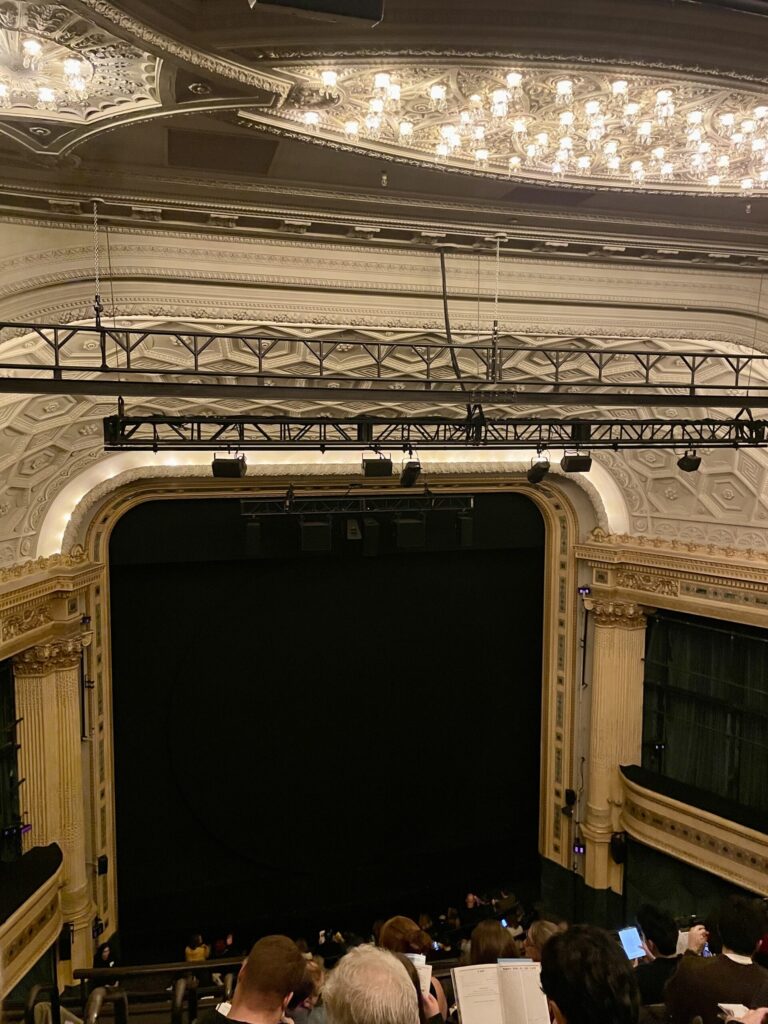
My wife, for the record, loved it. She found it bracing, honest, even comforting in its refusal to lie. Where I felt emotionally bludgeoned, she felt seen. And that difference, more than anything else, underscored what Waiting for Godot ultimately is: a mirror. It doesn’t tell you what to think or how to feel. It reflects back whatever you bring into the theater, amplifying it.
For some bros, especially those in a reflective or philosophical mood, this production will hit hard in the best way. It’s smart, disciplined, and unafraid to sit in silence. For others—especially those already feeling ground down by the weight of modern life—it may feel like an endurance test masquerading as art.
That doesn’t make it bad. It makes it demanding.
Broadway for Bros isn’t about pretending every show is a crowd-pleasing good time. Sometimes it’s about admitting, honestly, that great art can land at the wrong moment. Waiting for Godot remains a landmark of modern theater, and this production honors it with intelligence and care. I just wish I’d seen it on a night when the world (and my own head) felt a little less bleak.
Your mileage, as Beckett would probably say, will vary.
See you under the marquee. – Jim Thompson